Old Version
International

Myth to Meteorology Model

MAZU: China Intelligent Meteorological Early Warning Solution, rooted in the legend of an ancient Chinese figure named Lin Mo, who warned seafarers of weather disasters and is seen as a sea goddess after she died in a marine rescue, is helping countries and regions mitigate disastrous impacts through shared technologies

By Wu Jin Updated Nov.1

The MAZU Solution developed by China Meteorological Administration (CMA) is demonstrated at Shanghai’s World AI Conference (WAIC), July 18, 2026 (Photo by VCG)

Lin Haifang, a middle-aged fisher from Meizhou Island, Putian, Fujian Province, lost his entire crop of kelp and laver, another type of seaweed, after Typhoon Meranti hit his aquaculture farm in September 2016. 

With no warning systems as efficient as today's, he had no time to take preventive measures, such as submerging his laver nets and kelp ropes into deeper waters or postponing seedling cultivation before the storm lashed the island with wind speeds of more than 50 meters per second. 

"We were poorly informed back then, it took time for typhoon warnings to filter down to rural authorities," he told NewsChina. 

But since 2025, Lin has received accurate alerts from a smartphone app a few days ahead of bad weather. The app, designed by Fujian Meteorological Service, makes use of physics-driven modeling coupled with AI algorithms. 

Last year, Lin's aquatic production generated a 30-percent increase in profits year-on-year, earning more than 100,000 yuan (US$14,820), a considerable income for a fisher in the area.

The Solution
Fujian's early warning experience and meteorological technologies have contributed to China's Intelligent Meteorological Early Warning Solution, which integrates an advanced AI-powered weather warning solution. Officially named MAZU, the solution was released by the China Meteorological Administration (CMA) in July 2025. MAZU stands for Multi-hazard, Alert, Zero-gap and Universal. 

Named after a Chinese sea goddess, the solution is a tribute to the deity who safeguarded stricken seafarers. Mazu was born Lin Mo (960-987) on Meizhou Island during the Northern Song Dynasty (960-1127). MAZU: China Intelligent Meteorological Early Warning Solution is intended to safeguard people from all kinds of extreme weather events in and beyond China. 

Chinese President Xi Jinping announced on July 17 that China will enable 30 countries to use MAZU: China Intelligent Meteorological Early Warning Solution "to safeguard homes around the world," during a keynote speech at the opening ceremony of the 2026 World AI Conference (WAIC) and High-Level Meeting on Global AI Governance held in Shanghai from July 17-20. 

Customized versions of the early warning solution have launched in seven countries including Pakistan, Ethiopia, Solomon Islands and Djibouti so far. In addition, the project's implementation, including meteorological services tailored for aviation and tourism, has achieved interim progress in Egypt, China Central Television reported on September 4. 

In 2022, UN Secretary-General Antonio Guterres proposed the Early Warnings for All (EW4All) initiative, aiming to ensure universal protection from hazardous hydro-meteorological, climatological and related environmental events through life-saving multi-hazard early warning systems, anticipatory action and resilience efforts by the end of 2027, according to the World Meteorological Organization (WMO). 

In response, the CMA has provided access to the cloud-based early warning solution to other countries. More than 40 countries including Afghanistan, Laos and Thailand have used the solution through cloud services. 

To ensure proper use of the solution and to bring MAZU to more developing countries, China invited overseas meteorologists to the CMA to study the fundamentals and applications of China's early warning technologies and experience. 

"Early Warnings for All demands a step change in international cooperation, for the protection of people and property. China has been an important partner. Its platforms, satellites and AI models are already helping dozens of countries strengthen early-warning systems," Guterres said while addressing the meteorological forum at the WAIC 2026 in Shanghai. 

"This is the model the world needs, with technology transfer, joint research and local capacities helping countries protect their people," he said.

A CMA staff member (second from left) introduces the MAZU Solution, a meteorological early warning platform, during Shanghai’s WAIC, July 18, 2026 (Photo by VCG)

Earlier Warnings
On August 9, Typhoon Dolphin, an immense convective cyclone that formed in the Central Pacific, approached East China's Zhejiang Province. 

With a maximum velocity estimated at 45 meters per second, the typhoon triggered multiple alerts ahead of landfall. 

In Beijing, district weather stations issued Orange Typhoon Warnings (the second-highest) for severe thunderstorms lasting from the evening of August 11-13, suggesting the public cancel unnecessary outdoor activities. The warning, issued through schools, companies and institutes, was also sent out to people's phones on August 9. 

While the typhoon was not forecast to directly hit Putian in Fujian, authorities still issued the lowest level blue weather warning on August 8, cautioning people to be wary of thunderstorms and heavy precipitation, Huang Chunqiang, deputy secretary-general of Meizhou's Committee of the Communist Party of China, told NewsChina. 

Lin, who lives on Meizhou Island, was informed about the typhoon's track from his local warning app. Assisted by two port officers, he was able to make safe his offshore aquaculture facilities this time. 

"Previously, we depended on luck when we sailed out to sea. Now we can get back to port to reinforce our aquaculture farms when we get these timely, precise warnings," Lin said. "This means that losses caused by disastrous weather have been reduced substantially." 

On the southeast coast of China, Fujian is exposed to frequent typhoons and rainstorms. Its complex terrain, formed by mountains, hills and plains, means taking precautions against extreme weather is particularly challenging. 

In response to the demand for a more accurate warning system, in 2015, meteorologists in the province developed a localized Optimal Threat Score (OTS), an algorithm-supported calibration for precipitation forecasts. The system has since been upgraded, using historical forecasts and observations while optimizing mapping thresholds to help define alert levels. 

On October 27, 2025, "Fujian OTS" claimed top spot in the Fourth National Exchange Competition on Intelligent Forecasting Technologies and Methods organized by CMA's National Meteorological Center and CMA Meteorological Information Center. Because it has improved the precision of rainstorm and severe convective weather forecasting, the system was introduced in more than 20 other areas, including Hebei, Yunnan, Shaanxi and Jilin provinces. 

Fujian Meteorological Service has developed several other initiatives, including the "1262" Progressive Warning and Response Mechanism. The number refers to tiered emergency responses in three critical time nodes before severe weather disasters, such as rainstorms and typhoons. Cooperating with local governments, it issues alerts 12 hours before a natural disaster, deploys rescue teams six hours ahead and evacuates residents two hours in advance. 

In September 2024, it also released the Offshore Meteorological Navigation Service Platform to provide shipping forecasts, advisable routes and emergency warnings to deep-sea vessels. 

In the financial sector, the local database provides statistics required by insurance companies so compensation can be paid to affected people without on-site inspections after natural disasters.
 
Meanwhile, leveraging satellite remote sensing data, Fujian Meteorological Service can help generate tradable carbon sink credits, improve reservoir operation, send forest fire warnings and demonstrate three-dimensional transport scenarios for low-altitude flights. 

The ameliorated forecast, emergency responses and multi-pronged intelligent services have been integrated into MAZU in response to the EW4All initiative.

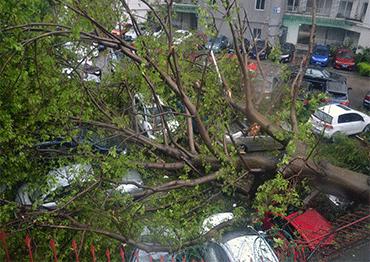
Cars are crushed by a fallen tree during Typhoon Meranti, Xiamen, Fujian Province, September 15, 2016 (Photo by VCG)

Upgraded Guardianship
On Meizhou Island sits the world's first Mazu Ancestral Temple, originally built in 987. Over the next millennium, the temple has fallen into ruin and been restored. At the top of the temple, a 14.35-meter granite sculpture of Mazu, built in 1991, towers over the island. 

The temple's halls, featuring many Mazu sculptures, including ones made of shells and gold, are shrouded in curling smoke from incense burned by the many visiting devotees. 

As a mortal, Lin Mo could foretell conditions at sea. Legend has it that her predictions saved many who canceled voyages when a storm was imminent. 

But she could not prevent her brother's death when he insisted on setting sail, despite her warnings of a coming storm. In 987, Lin Mo died attempting to rescue a sinking boat in a turbulent sea. To commemorate her intelligence, benevolence and bravery, locals built a memorial hall for her. 

In the ensuing years, she was bestowed with posthumous titles by emperors from the Song to the Qing Dynasty (1644-1911) after navigators described her divine protection at sea, according to some historical records, such as Record of the Reconstruction of Shunji Temple at the Ancestral Temple of Shengdun in Putian by Liao Pengfei in 1150. Shunji was Mazu's title in the Southern Song Dynasty (1127-1279). 

One of the most famous beneficiaries claiming to have been saved by her mythological force was imperial navigator Zheng He (approximately 1371-1433). To pay tribute to Mazu for safeguarding his crew while on voyages along the ancient Maritime Silk Road, Zheng erected a stone tablet to her in Changle in Fujian. 

In 2009, Mazu Belief and Customs was inscribed on the UNESCO intangible cultural heritage list. Deeply rooted in sea culture, today's Mazu Belief has over 300 million adherents across more than 50 countries and regions, according to Mayor of Putian Dai Longcheng, speaking at a press conference on August 5. 

Mazu's legend lives on not only in her temples, but also the advanced meteorological platform named for her. 

To build forecasts, MAZU's early warning solution draws data from a broad range of sources and models, including FENGYUN meteorological satellites, numerical prediction models based on mathematical models of atmospheric and oceanic data, cloud computing platforms and climate datasets, as well as several Feng-series meteorological AI models designed for short and long-range forecasting, according to the CMA. 

With comprehensive functions, MAZU can share disaster prevention and mitigation experience, develop precautionary forecasting systems, offer tailored services, send emergency support and arrange local deployment and operation. 

Apart from providing easy access to data and new technologies, it focuses on localizing services to target countries, inputting observation data, utilizing local early-warning mechanisms and cooperating with agencies involved in the partnership. 

The early warning solution can be applied to different fields, such as energy, transportation, low-altitude traffic and urban safety, in line with different demands. 

"Coordination among those who do research and development, business systems, governance mechanisms, personal competencies and indigenous operations accentuates the essence of MAZU, which allows us to secure a sustainable development of the early warning platform with our partners," Zhang Xingying, director-general of the CMA's Department of International Cooperation, said at the Putian press conference on August 5. 

"A millennium ago, Mazu spent her life trying to bring peace and harmony to the human community. Today, MAZU is safeguarding navigation and family reunions while transcending mountains and seas," he said.


Wider Cooperation
A few weeks after the severe heatwaves that affected Pakistan in May 2022, unprecedented floods triggered by monsoon downpours resulted in a death toll of over 1,600, according to the country's Disaster Management Authority. 

Having suffered the extreme drought with the catastrophic rainfall in the same year, meteorologist Shahzad Ali Shah with the Pakistan Meteorological Department feels the urgency of deploying a refined early warning network. 

"The frequency and intensity of extreme weather events keep growing, which poses massive challenges for Pakistan and many other nations. We urgently need to boost our disaster prediction and climate adaptation capabilities," Ali Shah, now a visiting scholar to CMA and Peking University, told News- China in August. 

"Pakistan already operates a national early warning network, and the early warning solution included in MAZU has greatly upgraded this system. It integrates all scattered monitoring and warning modules onto a single unified platform," he said. "Meteorologists can access all operational data from one single portal, which drastically speeds up decision-making and improves forecast accuracy." 

Since March, Ali Shah and fellow meteorologists from Benin, Azerbaijan, Laos and Rwanda have been exploring what MAZU can do through an academic exchange program initiated by China. 

As of 2024, nearly 1,000 meteorologists from more than 100 developing countries have received training on meteorological early-warning technologies from China, Zhang of the CMA said. 

Today, MAZU provides more than 200 tailored products to different countries while promoting knowledge sharing, including through free training. 

"This program lets us learn not only from China, but also from fellow international participants. We exchange insights on the unique meteorological challenges each country faces. Some risks are shared, while others are region-specific," Ali Shah said. 

"These cross-country exchanges offer valuable supplementary experience beyond Chinese technical training," he said.

Print